Showing posts with label review. Show all posts

Tuesday, August 28, 2012

CBC Summer Shows Review.

The summer is nearly over, and so one of my favourite parts of it is coming to a close, CBC Radio One's summer programming.

For years now for me, CBC's summer radio shows have been a fascinating listening experience give its radio network an enhanced variety that is lamentably missing through its regular season, and its looming budget realities mean the situation is hardly going to improve. As it is, the shows have had to be fewer original series and more repackaged reruns like Vinyl Cafe Stories and The Current's reruns of the concluded season's theme of  stories like Gamechanger.

But as it is, there still have been enjoyable shows to listen to of varying quality this summer and a few thoughts about them is in order:

The real treat has been The Wildside, an enthralling fun show about adventures in the Canadian wilderness.  The story in the first episode about Wes Werbowy,  the wilderness consultant who survived a polar bear intrusion into his tent with an impulsive punch on the nose got me and kept me listening with growing pleasure. That was followed up with great anecdotes and interviews from people like a woman who had to stop a walrus from trying to mate with her canoe and crushing it, a man's whose wilderness jog was joined by a non-aggressive pack of wolves for a stretch and two girls who were attacked by a belligerent grouse that had to be peppersprayed.  All told with good music tracks played, is the epitome of fun summer radio.

Babel was an intriguing summer show about the use of English, especially from an immigrant point of view.  English has been described as one of the most difficult languages to learn with its myriad of words and language rules that are rife with exceptions and this show is an enlightening reminder about that kind of perspective about its challenges from the newcomer.  In other words, it's like the old show, And Sometimes Y, from a non-native anglophone perspective that a whitebread guy like me could bear to understand.

Metamorphosis struck me as a somewhat sunnier version of The Late Show considering the stories are predominately not obituaries. Unlike Gordan Pinsent's wizened drawl, Richard Syratt has a wry tone with a touch of gravel that allows for a welcome neutrality. The stories thankfully have variety like, Jose Prado, the Colombian double arm amputee charity case who fouls up horribly is a standout with others who have cleaned up their lives like Mary Johnson and Oshea Israel, a mother and her son's murderer who managed to make peace. The whole series give a fun mix of about how people cope with mistakes and misfortunes that is an inspiration and eyeopener.

Trailbreakers: This series has some interesting profiles of Native American community leaders who are advancing their people like encouraging business, political activism and broadcasting. However, the show feels disappointingly conventional compared to the early Native American show, Revision Quest, starring Darrell Dennis with his comedy sketches and his overall sense of humour to give the real story about his people.

Fear Itself has a quirky series about human fears, but I couldn't get into that. I prefer stories to enlighten and inspire me and there's enough fear in my life without going out of my way to explore more. Don't get me wrong, the show is interesting in and of itself, but it was not something to get me to archive the podcasts like other shows like Know Your Rights.

The Invisible Hand on the other hand was a show you can't approach ignorantly. As David Bush noted in Rabble.ca, the host, Matthew Lazin-Ryder, has a neo-conservative bias that colours the show to say the least. For myself, I was suspicious from the start about with the first episode being about, price gouging such as using the example of selling ice during a major community disaster. Listening to his case about priorities and his claim of how banning price gouging leads to dangerous shortages sounded maddeningly simplistic; for instance, there is no mention of intelligent rationing such as what Canada and the US imposed during World War II with their ration cards.  The show was still interesting, but it shouldn't in part be because it is a ideological minefield to beware Lazin-Ryder's agenda, even if he is at least rational enough to address real issues like global warming in the context of economics.

Global Perspectives manages to largely avoid the occasional dryness with the international documentaries with the "Old School, New School" theme such as an old shop with changing hands both in generations and in perspective to getting modern kids in China interested in Peking Opera.  It's a pity that the show is not podcast, but its episodes are available on its website.

If you like good radio, warts and all, then check out these shows and experience Canadian aural experiences that only CBC Radio One can provide. 


Tuesday, August 21, 2012

Changing Perspectives of Films and their Times.

It's interesting how a view of a film can shift over the years.


For instance, Orson Welles' Citizen Kane has finally been toppled after decades on top of the British Film Institute's Top 10 films of all time list in favour of Alfred Hitchcock's Vertigo.  It certainly shouldn't be a surprise apparently since it had been rising in critical favour for decades. For myself, Citizen Kane is an interesting film with its wit and a bleakly satiric look at the American Dream at its materialistic worst with bold cinematic techniques to tell that story.  By contrast, Vertigo does have the virtues of nightmarish surrealism and it's own bleak tragedy of obsession, even when it's for the truth, to make for a interesting film experience.

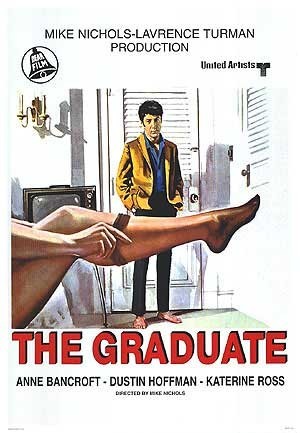
Now, Mike Nichols seems to inspire similar reassessments such as with the great film critic, Roger Ebert, changing his tune about The Graduate. In 1967, he praised the film to the skies with his affection for Dustin Hoffman's Benjamin Braddock and then thirty years later, sympathizing for the ostensibly villainous Mrs. Robinson dealing with Ben who Ebert now calls an "insufferable creep." Yet, he still likes the film, but more has a museum piece of  whose time has passed, except for Simon and Garfunkel's music, which contrary to his first review, turned out to be not "forgettable" at all.

For myself, I can never have Ebert's perspective reviewing Nichol's greatest films considering he first saw them in the 1960s when they shook up the Hollywood film with their bold content for their time.  I can only rely on a historical perspective and appreciate them in that context, but my own perspective and my tastes in film will reflect my time on a visceral level I just can't shake.

In that regard, I finally got myself to see Who's Afraid of Virginia Woolf, Mike Nichols' 1966 mega-successful adaptation of  Edward Albee's classic play. This was a film with such raw content that dealt a heavy blow to Hollywood's stifling Production Code and paved the way to more freedom for American film, if imperfectly.

However, for all this appreciation, I can't escape the fact that the film was almost unwatchable to me. The whole story about this bitter couple continually sniping at each other and sucking a young couple in repellently divorced from any real humanity or character logic. At no time do Richard Burton and Elizabeth Taylor's characters seem to convey one gram of warm or humanity, but carry on as nightmare caricatures of domestic emotional hell.

Furthermore, the younger couple seem to act with any feeling of basic common sense or self-preservation. After all, when someone visits a couple who are sniping at each other so hatefully that the husband brandishes a rifle at her, you'd expect any visitor would practically be running for the door.Yet, these twits stay after all and get sucked into their vicious mutual emotional torture. So, I'm expecting to be interested in seeing two emotional sadists wreak havoc with their drunken idiocies while two young nitwits go along with all this, even to the point of taking a ride with them to a bar to make it a public spectacle?  Yes, by the end, there is a shocking revelation that can give the main couple's turmoil a bit of perspective, but it is far too late in the story for me to care.

I've read that part of the appeal for its time was not only the lure of the forbidden with the rough material, but also two of the biggest stars of that time indulging in such wild antics that were once thoroughly hidden behind closed film doors.  As it is, I've grown up in a time when such material is now commonplace for TV movies and the simple shock value has long since faded. As much as I bet Albee's original play has a more nuance tone that can be properly toned for today in the confines of the stage, this film just feels like a gleeful sledgehammer that had already flattened the play's possible subtleties for a generation that was perhaps not ready for them in that medium.

Christopher Reeve, an actor's actor.
Then there is also the fact that this film was a star vehicle for Burton and Taylor.  For myself, I try to avoid seeing films because of the actors, but I first grew to like film like Star Wars and Superman where the larger story is paramount and the actors playing it who best suited to it was all important.  To me, Christopher Reeve is my ideal; a relatively unknown actor hired to play the Man of Steel, but had to do so in the shadow of Marlon Brando and Gene Hackman in third billing. Yet, Reeve is the one who proved himself brilliantly in a fantasy role that could have been hopelessly silly, but made it feel so warmly believable and appealing on its own terms.

Since then, and helped along by being bored to tears with Star Trek: the Motion Picture's glossy, but crashingly boring tale I look to story and the skill telling it above all else. Then again, I am also someone who consults the film review aggregator Rotten Tomatoes more than any publicity or advertising for films to see.  I'm not immune to good marketing such my interest in the upcoming animation film, Wreck-It Ralph, with its enthralling trailer, but that is balanced against the suspense to waiting for its RT score to say whether it lives up to it.

With that in mind, I plan to be writing reviews of older films on top of other subjects for this blog to see what a modern perspective can bring and see what I can discover.

Thursday, August 16, 2012

Prohibition, A TV documentary review

When it comes to American history, few American documentary filmmaker on TV can match Ken Burns.

His film have a powerfully engaging effect that seems to work best with his own voice when he has the least amount of material work with.  For example, for events that occurred before the advent of film, such as The Civil War, he is able to create evocative scenes with paintings and landscape shots that seem make motion almost superfluous.  That is further enhanced with great actors reading the writings of great historical figures like Sam Waterston as Abraham Lincoln, Morgan Freeman as Frederick Douglass and Julie Harris as Mary Chestnut.

Last night, I had a binge of sorts watching Burns' documentary of last year, Prohibition.  As usual, it was an insightful look at one of the United States' most disastrous constitutional mistakes when it tried to ban the sale of alcohol.  Starting from a well meaning activist urge to control the social problems arising from America's obsession alcohol,  it blew up into a national imposition arising from a toxic mix of nativist prejudice and ethnic anxiety, dosed with a jigger of self-righteousness fueled with political savvy as the 18th amendment of the US Constitution..

From that supreme act, you will find a intriguing story of how good intentions created some of most serious blowback as organized crime instantly took advantage a ready market created by the draconian in definition Volstead Act that was enforced by underfunded and undermanned Prohibition Bureau under an underenthusiastic political leadership.

Against this, you have colorful tales of bootleggers, rumrunners and gangsters of which Al Capone was simply the most self-grandizing of the bunch.  Opposing them, you will understand how that side was hardly much better, especially when the head of the bureau, who was willing to encourage the trampling civil liberties in her methods as part of regular business, was willing to directly interfere with the 1928 Presidential election by spewing religious hate, a sentiment in principle shared by that other supporting group, The Ku Klux Klan.

Furthermore, you will see how this conflict infected much of American society as alcohol became the ultimate forbidden fruit, leading to a widespread attitude of secret defiance that became fashionable to a self-destructive degree. In fact, the social activism dedicated to ending prohibition is a real eye-opener like the well to do society lady, Pauline Sabin and the mayor of New York City, Fiorella La Guarida.

The only major disappointments is that I wish Burns could have focused a bit more on some of the well meaning and famous heroes of the era like Izzy and Moe and Eliot Ness and his Untouchables.  However, the tragic story of that rural enforcer in the mountains who did his duty and pay for it with his life goes a long way about the era's costs.

Furthermore, I wish Burns could have drawn the obvious parallels with the current narcotics prohibition which is proving not much less self-defeating and ineffectual itself. As much as I am a teetotaler, this series becomes a intelligent fable on the perils of social reform overreaching itself and making things worse in the long run.

Thursday, July 12, 2012

Pictures at a Revolution: a personal book review

Of all the books about film I have read, or more precisely listened to in audiobook, there is one that I keep returning to, Pictures at a Revolution: Five Films and the Birth of the New Hollywood by Mark Harris

This book is an endlessly fascinating history about one of the most tumultuous periods of Hollywood in the mid 1960s.  In that time, the American film industry underwent a dramatic transition as the old guard of Hollywood found its hegemony challenged by a new generation of filmmakers with a new sensibility to the art even as the veterans tried and true ways proved to be neither anymore. In that time, the 1967 Picture Oscar Nominees proved to be a microcosm of this conflict like the roguish French influenced Bonnie and Clyde, the youth oriented iconoclastic satire of The Graduate faced off against the stogy Guess Who's Coming to Dinner and the mainstream artistic and box office fiasco Doctor Dolittle while the searing detective drama, In the Heat of the Night found itself as much in the middle of this divide as its Black star, Sidney Poitier.

Along the way, you will enjoy bracing sidestories like the fall of Hollywood's production code as its censors found themselves out of touch and out of time in a world and how television finally changed from a simple threat to the film medium into a valuable tool that helped make new cinematic visions possible. On a larger scale, there is the competing influences of film as the French New Wave influenced the young turks like Warren Beatty, Arthur Penn and Mike Nichols to take a more personal and less inhibited approach to film.  Meanwhile, the mainstream studio establishment misread the brief fad for big budget musicals like My Fair Lady, The Sound of Music and Mary Poppins to set themselves up for a disastrous box office reckoning that would break the back of their power even while United Artists showed the way forward with a new looser business model that made the new media mainstays like the James Bond series possible.

Finally, there are the lives of the actors of this time they had to ride this storm with their own ways in enthralling stories.  There is Rex Harrison, a veteran actor who tried to take advantage of his mainstream break-out and squandered it as a drunken hateful prima donna on Doctor Dolittle, a film whose botched creation is more comically entertaining than the movie itself.. Against that, you have the struggles of Dustin Hoffman, a Jewish actor of the highest artistic ideals who found himself hitting the big time in the way he least expected, and opened up what was possible for actors of various ethnicities.  However, you will also see the slightly sad story of Sidney Poitier, a breakthrough Black film star who paid the price of too many of his employer's prejudices and the strictures of his own ideals and frustrations as the burden of being both a pioneer and a token began to sink his career.

Finally, this book is a enticing callback to an entirely different time of being a film fan decades before home video when filmgoing could be a enriching social occasion of ideas for the discriminating fan while seeing vintage stuff was a rare treat that required connections and the determination to make that possible.

In short, this film will give you a new appreciation of mainstream film in a time when Hollywood began to realize its old ways were self-destructing, but saw a future where newcomers could make it so much more.

Tuesday, May 24, 2011

Now that Harold Camping is doing the usual Apocalypse prophet excuses and Oprah has had her send off for her talk show, the way seems clear enough for Kung Fu Panda to get its fair share of media attention this week.

However, I've discovered that for films I'm looking forward to, there is a drama to them that begins long before they are screened.  That happens when you follow the film's status on the movie review aggregator site, Rotten Tomatoes, in the days leading up to its release.

It's hard to believe that seeing the updates of a percentage number can be so suspenseful, but each film is an artistic crapshoot and that even the greatest filmmakers have created their share of bombs.  Thus, as the release date approaches, the regular updating of the film's Tomatometer rating becomes a roller coaster ride as you wait to see where the critics are leaning.  That especially goes for the films hovering around the vital 60% that marks it as Fresh or Rotten as you endure the rise and dip as the opinions mount.  There's even a finish line to this challenge when the tally is clear enough for a consensus statement to be issued as the final word, except when it isn't when a late shift comes dramatically enough to force a rewrite.

So, however much criticism of RT deserves of reducing film reviews to a vote tally, the fact remains that the site provides a unique thrill to the filmgoing experience that is supposed to consciously defy the hype. Instead, I can know the hopefully well considered opinions of critic who simply want to say if a film is any good. When that happens, I'm sold in a way that beats glossy trailers or commercials any day.

As it is, Kung Fu Panda has 83% so far with only 6 reviews, so the ride to Thursday is just beginning with a hopeful start.

Thursday, May 19, 2011

I forgot to mention that I am a local theatrical and film critic in my city, writing for Theatre in London (www.theatreinlondon.ca) and The Beat (www.beatmagazine.ca) for each medium respectively, as well as for gratis and for pay in the same way.

Since writing means tooting your own horn for your very career future, I'll be posting my links to my reviews, beginning with my latest:

How I Learned to Drive by Paul Vogel and performed by The Verve Theatre company

It's a challenging play about abusive families and the difficult emotional complexities that thrive in them.